A practical guide
What is an ATS? A Practical Guide to Why Recruiters May Never See Your CV
Working continuously with job seekers, hundreds of CVs pass through my hands each month across very different sectors: tech, marketing, customer service, finance, retail, and beyond. That breadth makes a clear pattern visible — the CVs that get callbacks, and the CVs that disappear entirely.
The difference rarely comes down to qualifications. Most of the time it comes down to a technical intermediary between the candidate and the recruiter, known as the ATS. This guide explains how that system works in plain language, and shows you how to write a CV that consistently gets through it.
What is an ATS?
ATS stands for Applicant Tracking System. In simple terms, it is the software companies use to receive, organise, and search through CVs against the criteria of each open role.
Most large Saudi employers rely on this kind of system — from banks and telcos to Aramco, SABIC, and government entities. The key thing to understand is that these systems operate on strict, literal logic rather than human judgement, and understanding that logic is the key to passing them.
First: the system matches words literally
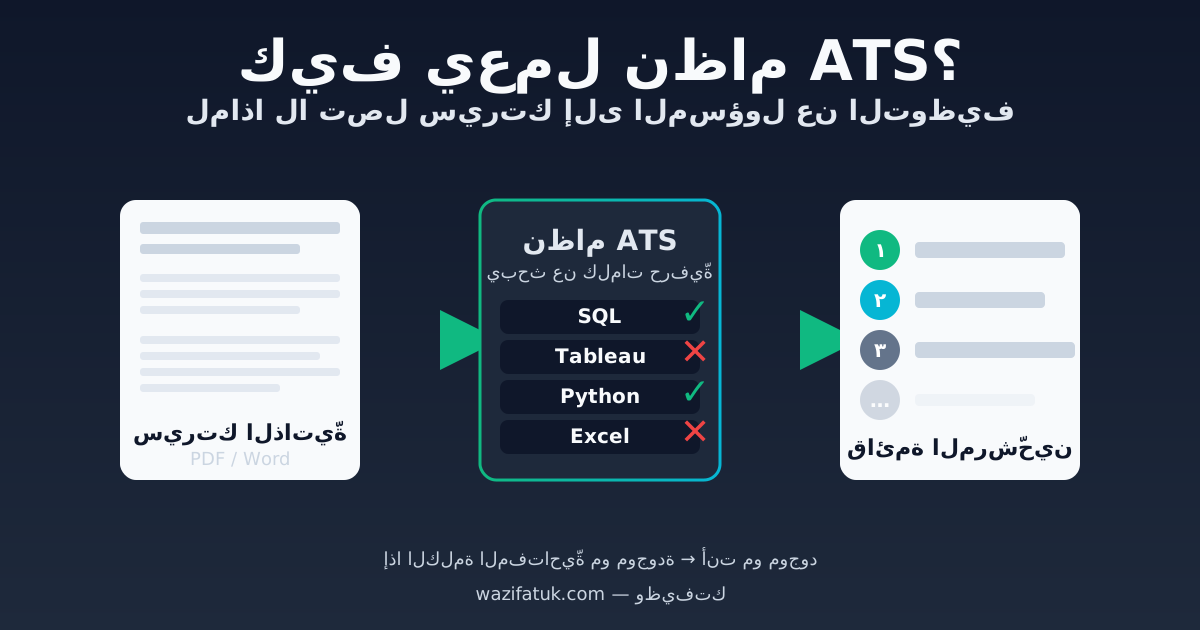
This is the most important point: an ATS searches for the exact words found in the job advert. It does not interpret synonyms or context the way a human recruiter would.
A concrete example: an advert asks for "SQL and Tableau", while your CV mentions "querying experience and data visualisation". The meaning is identical, but the system fails to find the two specific words, so it ranks you lower in the candidate list — sometimes low enough that the recruiter never reaches you.
The takeaway
Use the keywords from the job advert verbatim, woven into natural sentences that describe your actual work. This one habit measurably increases the chance your CV reaches a human reader.
Second: design templates can work against you
CV templates from Canva and similar tools are visually appealing, but they often confuse ATS software, which converts the file to plain text before parsing it.
When information sits inside icons, text boxes, or multi-column layouts, the parser may fail to extract it. The result can be a CV that — from the system's perspective — has no phone number or email, even though it looks perfectly clear to the human eye.
Third: the system ranks — it does not reject
It is important to understand that an ATS usually does not issue a direct accept-or-reject verdict. What it does is rank candidates by how closely they match the criteria.
- The recruiter enters search criteria (e.g., a candidate skilled in Python with 3+ years of experience).
- The system surfaces only CVs containing those exact terms, ranked by match score.
- CVs missing the terms do not appear in the result list at all.
Why this matters
Silence from an employer rarely means the recruiter read your CV and passed. It usually means the recruiter never saw it in the first place.
Fourth: formatting that confuses parsers
Many companies still run older versions of ATS software, which makes certain design choices a direct cause of lost content. The most common culprits:
- Tables for skills or work experience.
- Text boxes used to highlight titles or sections.
- Decorative icons replacing words (a phone icon instead of the word "phone").
- Non-standard fonts, especially decorative ones.
- Images that contain meaningful text, such as a previous employer's logo with their name inside it.
Fifth: simple rules that get you through
You do not need complex formatting or specialised tools. Following these guidelines is usually enough:
- Use a clean single-column layout with clear section headings.
- Repeat the keywords from the job advert in natural phrasing within your experience descriptions.
- Avoid icons, text boxes, and tables for core information.
- Save as a text-based PDF you can copy from (a quick test: select the text and copy it — if you can, the parser can too).
- Make sure the CV stays comfortable and clear for a human reader, since they make the final call.
Bottom line
The goal of these rules is not to "game" the system, but to ensure your content arrives fully intact to the person making the decision. A CV structured this way reaches the recruiter, gets read, and is judged on its substance — which is all you need.
FAQ
- How can I tell if my CV is ATS-readable?
- Open the file, select all the text, and paste it into a simple text editor like Notepad. If it appears in the correct order and reads cleanly, the parser will read it the same way. If it is scrambled or full of strange gaps, you have a formatting issue to fix.
- Do I need to tailor my CV for every job?
- A full rewrite is unnecessary. Adjusting the summary and skills section to reflect each advert's keywords is usually enough — and Wadiftech's tailoring tool does exactly this automatically for every job.
- Do modern ATS systems handle Arabic well?
- Modern systems such as Oracle Taleo, Workday, and SAP SuccessFactors handle Arabic well. Older systems may struggle, so when applying in Arabic prefer a simple single-column layout in a font like Tajawal or Arial.
- Does hidden white-text keyword stuffing work?
- No. This is an outdated tactic. Modern systems detect it instantly, disqualify the CV, and may flag a negative note against the applicant.
- Do all Saudi companies use ATS?
- Large and mid-sized employers use them widely. Smaller companies in retail, F&B, and some early-stage startups may still review CVs manually. Even so, an ATS-friendly format remains clearer and easier to read for humans as well.
Score your CV against a real matching engine
Wadiftech uses an AI model that mirrors how modern ATS software actually works, giving you a precise match score for every LinkedIn job along with specific recommendations to improve your CV.